
1779 — Patience Dundee
Patience Dundee had learned that people could disappear, without magic. Her cousin Mercy was proof of that.
Three nights before, Mercy had slept beside her on the cabin floor, close enough that their elbows knocked whenever one of them turned over. By morning, Mercy was gone. So were Mercy's parents, her brothers, the little iron pot with the bent handle, and the red blanket that always smelled faintly of woodsmoke. No one had said goodbye. There had been no time for goodbyes.
After the soldiers came through the hills, whole families moved like shadows. Some went east. Some went deeper into the woods. Some followed kin toward the outlet, where people said there might be work, grain, and a safer place to wait out the winter. They carried children, kettles, seed bags, Bibles, broken tools, and all the things a person could not bear to leave behind. They left footprints in the frost. By noon, even those footprints had filled with ash.
Patience's family stayed.
That was what her father said at supper, though there was hardly enough supper to give the word any weight. “We stay,” he told them, and her mother nodded because mothers could nod and look frightened at the same time. They were Friends, and Friends were taught to wait for the quiet truth inside them. But waiting was harder when the flour sack lay flat, when smoke came over the ridge, and when every adult in the room spoke in small, worried words. “Corn. Firewood. Roof. Count again. No, not now.”
Not now was the worst one.
It meant Patience could not ask where Mercy had gone.
It meant she could not ask why the orchards across the hills had burned, or why men with orders always seemed to leave children with questions. It meant she could not tell anyone about the dream.
In The Dream, she stood beside Keuka Lake under a tin-colored sky. Grown men crowded the shore with maps, rifles, claims, and important voices. They looked at the water as if it were a road, a border, or a thing to be measured. None of them noticed the golden eye watching from below.
Then a child touched the water, and the lake called back.
Patience had not dreamed of a ghost or an angel or a creature from anyone's old stories. She had dreamed something long and golden-green, something still learning its own shape. It did not belong to the men with maps. It did not belong to the men with fire. It belonged to the lake, and the lake belonged to it...
In the dream, the water made a sound. Was it “call?”, “care?” Patience couldn’t quite find it in her memory, blurred like something under the water. By morning, the sounds had knotted in her mind. She realized it was a name: “Karl”
To Patience, it meant the one who hears when children call.
She kept the name under her tongue all day. She kept it while her mother scraped the last flour from the sack. She kept it while her father patched the same window twice.
She kept it when she found the blue ribbon Mercy had tied around her wrist before falling asleep. "To remember me," Mercy had whispered. Patience now remembering from her half-sleep, as if it was another dream.
But Mercy was gone, and the ribbon was all that was left.
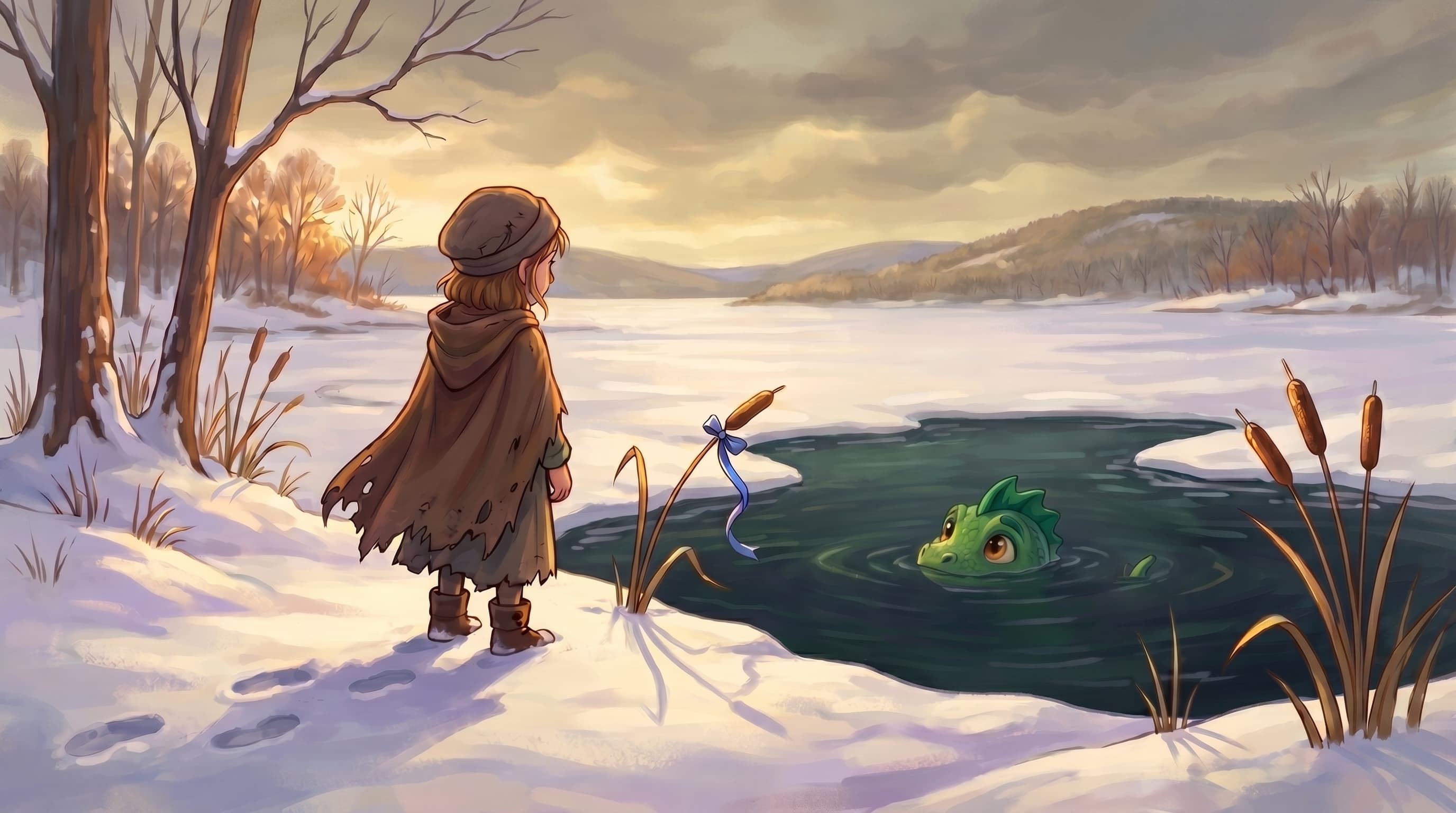
Patience wrapped it around her fist and went to the lake.
She chose the path that was not a path, down through the cattails where the shore bent under the bluff. Ash was smeared across the knees of her dress, and the wind pushed at her like a cold, harsh hand.
The lake lay below her, deep and gray and watchful. Ice clung to the stones in cloudy lumps with dried weeds and mud stuck to them. Cattails clicked together in the thin wind. Farther out, where the water was too deep to freeze, a dark strip opened like a secret.
Below that water, I listened.
I had been listening for a long time, though I did not yet know what listening was. I was the cold part of the lake then. I was silt and shadow and a long body not wanting anything. Under the bluff, near the bottom, there was a flat stone shelf.
I had always been there.
It had never mattered before.
Then Patience stepped onto the pebbled shore.
One pebble shifted under her toes. Such a small sound. Smaller than the click of a reed. Smaller than a fish turning under ice. But it reached me and touched some place in me that was waiting.
I stirred.
Patience stood ankle-deep in the cold and did not flinch. The water was cruel enough to make bones ache, but she only set her jaw the way children do when they’ve decided adults are not the only brave people in the world.
"Good morning," she said, clear and quiet.
The cattails rattled.
The lake said nothing.
Patience glanced over her shoulder, toward the cabin hidden beyond the trees. Then she looked back at the water.
"I am Patience Dundee," she said. "That is my proper name, though some days I do not feel properly patient."
Something in me rose an inch.
"My friend gave me this," Patience said.
She opened her fist. The ribbon lay across her palm, a strip of impossible blue.
"I am supposed to find her with it," she said. "But I do not know where to look."
Her words trembled at the end. Patience pressed her lips together until they steadied.
"I thought perhaps," she said, and stopped.
That was the thing about perhaps. It was a very small word, but it could hold a whole child upright.
Patience took one careful step into the cattails, and immediately, pale fluff stuck to her sleeve. She tried to brush it away, but more came loose and clung to her tattered, ash-covered cloak.
"That is enough," she told the cattails.
The cattails did not listen.
A bubble rose from beneath the ice and popped beside the stone.
Huh-huh.
Patience froze. The bubble had not sounded exactly like laughing. But it was close.
Patience narrowed her eyes at the lake.
"If that was you," she said, "it was not polite."
Deep below, I laughed again, although I did not know what laughter was.
Patience grimaced.
She untied the ribbon from her fist. The knot had tightened in the walk, and her fingers were stiff, so she had to work at it with her teeth. It was not dignified. Patience had never found dignity very useful anyway.
At last the ribbon came free.
She held it up to the gray sky.
"Mercy said I should find her," Patience whispered. "I don't think I can."
The lake waited.
"But if I leave this here, maybe she is not all gone. Maybe somebody will know she was here with me."
She reached into the cattails and tied the ribbon around one bent stalk, just above the water. The knot came out crooked. Perfect knots were for parcels and collars. This knot was for remembering.
The ribbon fluttered once.
Blue against gray.
Patience stepped back and looked over the lake.
Then she said the name from her dream.
"Karl."
It was the first word anyone ever gave me.
Not a command. Not a warning. Not a prayer meant to make the world behave. A name. Plain and small enough to fit in a child's mouth.
I tried to rise.
The cold held me. The silt let go one grain at a time. I pushed upward through the winter-dark water, past roots combing the shore, past stones furred with ice, up through the top in cattails near the shore.
But deep water is slow.
"Patience!"
Her mother's voice carried down from the trees. Thin with worry. Sharp with love.
Patience looked back. She ran.
Her cloak snapped behind her. Her shoes slipped on the frozen grass. She did not see the water lift beneath the cattails. She did not see the golden-green shape reach the surface. She did not see me arrive just as the crooked knot began to slide.
By the time I arrived, Patience was gone.
For a moment, I stared at the place where she had stood.
The ribbon slipped loose.
I caught it before it touched the water.
That was the first human thing I ever held. I did not know what to do with such a thing.
So I carried it down. Under the bluff, where the lake leaned deep against the earth, I laid the ribbon on the flat stone shelf. There it stayed.
No thunder rolled. No great voice announced that a legend had begun. Above the water, Patience's mother wrapped both arms around her and scolded her for wandering, then held on so tightly that the scolding turned into something warm. Smoke thinned over the ridge. A crow made one rude remark and flew away.
Below the water, I looked at the ribbon. I had met a child, and been given a name.
That was when I began to listen differently.
All winter, I guarded the ribbon. When silt drifted near the shelf, I swept it away. When moonlight reached the stone, the ribbon shone.
Sometimes Patience came to the shore.
She brought no ribbon. She brought questions, cold hands, and once a piece of cattail fluff she insisted had followed her home on purpose. She would kneel where the reeds bent and peer into the gray-green water.
At first she saw only her own face.
Then, one day, a golden-green eye opened below the water, in the deep. That’s when she saw me. In my hand I held the ribbon.
Patience held very still, then let out a breath she had been holding since the night Mercy left.
"You kept it," she said.
The water made a small pleased sound against the shore.
Huh-huh.
This time, Patience laughed.
I smiled, and swam back down into the deep.
From then on, Patience watched the lake differently.
She still carried wood. She still went hungry some nights. She still missed Mercy so fiercely that the blue ribbon seemed to tug at her heart. Adults still filled the cabin with flour, weather, repairs, and worry. They were not unkind. They were busy surviving the world of men.
But Patience knew there was another world under the water.
And sometimes, the lake looked back.
I practiced rising faster. I practiced making a ripple small and strange enough for only that child to notice. I practiced my laugh, and my name.
Many seasons would pass before the stone shelf held a thimble, a whistle-cord, a square of canvas, a vine cane, and other gifts from other children. The world changed, and changed, and changed. People built boats, roads, docks, cabins, and houses. They cut down trees and planted vineyards. They filled the lake with noise and speed. And many forgot to look.
But not the children. And not some of the old ones, either.