
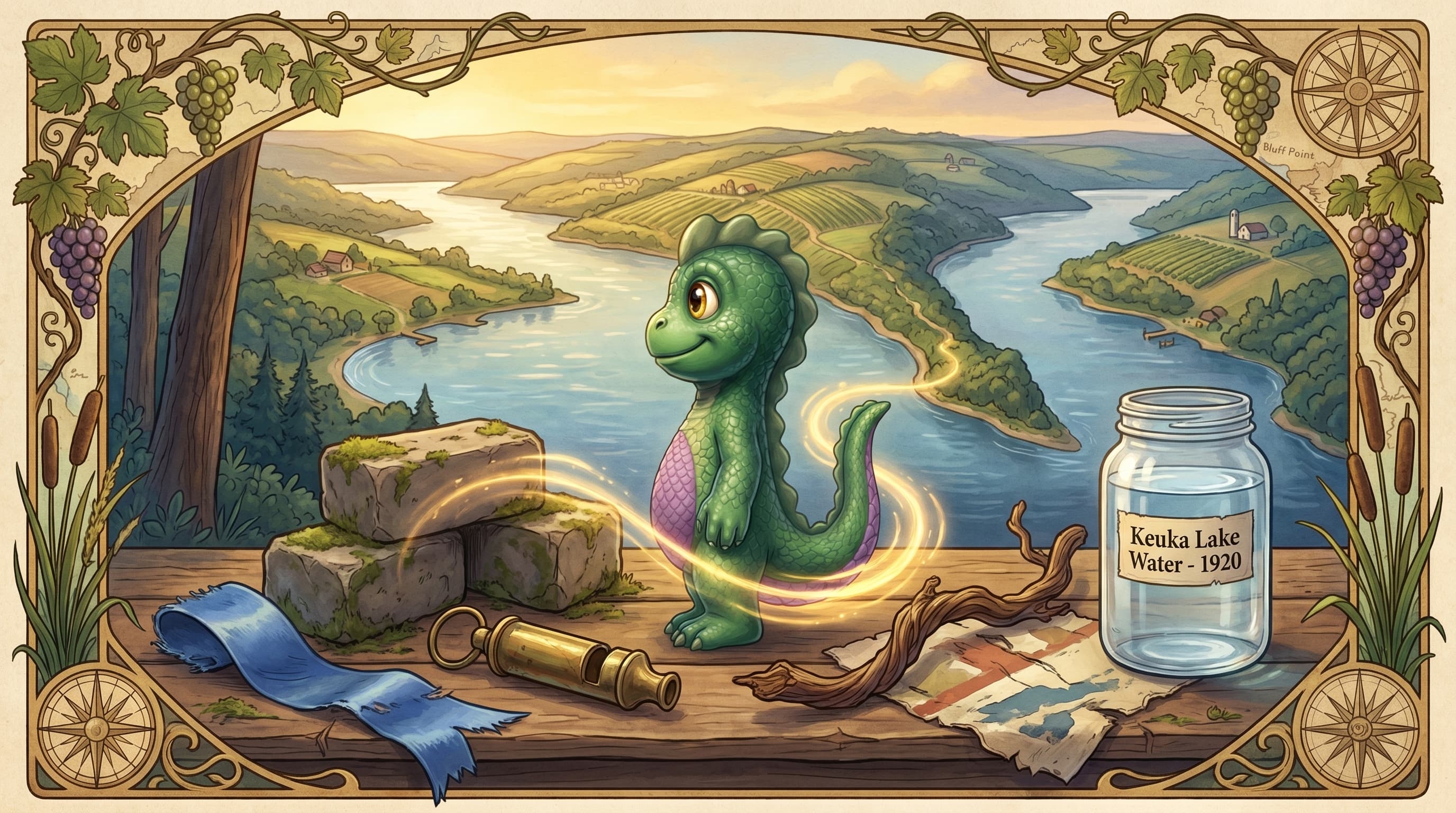
REAL LAKE, REAL PLACES, REAL CARE
History of Keuka
A guided walk through Keuka Lake's shape, communities, industries, inventions, vineyards, and living water.
Keuka Lake has always been more than a view. Its crooked Y shape, steep wooded slopes, working water, farms, villages, parks, and deep cold coves have shaped how people travel, build, work, gather, and care for this place.
This guide follows the lake from its geography and earliest human history through settlement, industry, wine, steamboats, trolleys, aviation, conservation, and modern lake stewardship. It is meant for first-time visitors, families, students, longtime lake people, and anyone who wants the Legend of Keuka Karl to sit beside a clearer sense of the real lake.
Karl belongs to the story. Keuka belongs to the people and communities who have known, used, studied, protected, and loved the lake across generations.
WAYS TO EXPLORE
Start with the shape
Find the two northern arms, Bluff Point, Penn Yan, Branchport, Hammondsport, and the southern stem.
Honor first histories
Begin deeper regional history with Native sources and remember that Keuka's human story long predates the modern villages.
Follow working water
Trace how the lake, outlet, mills, boats, farms, vineyards, and rail connections shaped daily life.
Visit by place
Use parks, trails, museums, wineries, town histories, and shoreline views as entry points.
Practice care
Let history lead into present-day lakekeeping: clean gear, watch the water, respect shorelines, and leave the lake better.
The Long Arc of Keuka
Keuka Lake is famous for its crooked Y. One arm reaches northwest toward Branchport. Another reaches northeast toward Penn Yan. The lake narrows and runs south to Hammondsport. Between the arms, Bluff Point rises like a long green divider.
That shape influenced nearly everything that came later. Water offered travel and trade. The Outlet carried power east toward Seneca Lake. Hillsides held farms and vineyards. Villages grew where roads, water, mills, and docks made daily work possible.
Keuka feels intimate because the opposite shore is often visible. It is large enough to hold weather, depth, and mystery, but close enough that a visitor can read the land: a dock here, a vineyard slope there, a bluff, a village, a road, a boat crossing late in the day.
WHY IT MATTERS
The best way to understand Keuka is to start with the shoreline. Names such as Bluff Point, Penn Yan, Branchport, Hammondsport, the Outlet, the Bluff, and the two arms turn a pretty lake into a place with memory.
A Respectful Beginning
Keuka's human history begins long before Penn Yan, Branchport, Hammondsport, steamboats, wineries, cottages, or tourist maps. The lake sits within a wider Finger Lakes region with deep Haudenosaunee history.
The Seneca are one of the Six Nations of the Haudenosaunee Confederacy. The Seneca Nation describes itself as the westernmost Nation and as the Great Hill People. Readers who want to understand this deeper regional history should begin with sources from Native Nations themselves.
A local legend can be warm and imaginative while still being careful. The responsible approach is to name the older history, point readers toward Native sources, and avoid borrowing sacred stories, ceremonies, or identities to decorate a new fictional character.
WHY IT MATTERS
Respectful storytelling makes room for both imagination and truth. It reminds visitors that every dock, trail, vineyard, and village sits in a region whose human story began long before the modern lake map.
War and Displacement in the Finger Lakes
The Revolutionary War reached Haudenosaunee homelands with severe consequences. In 1779, the Sullivan-Clinton Campaign brought Continental forces through the region. The National Park Service describes the campaign as an effort to destroy villages and food supplies of the Cayuga and Seneca Nations.
Newtown Battlefield State Park preserves one major campaign site. The broader history includes violence, displacement, burned food stores, broken homes, and the uncertainty that follows when families are forced to move or survive a winter with less than they need.
For a visitor, this part of the lake's past should be approached with humility. It is not scenic background. It is part of the human cost behind the region's later settlement and growth.
WHY IT MATTERS
The year 1779 helps explain why small household objects can carry so much feeling in a story: a ribbon, a blanket, a pot, a doorway, a child's memory of who was there before everything changed.
The Keuka Outlet
The Keuka Outlet carries water east from Keuka Lake toward Seneca Lake. Its drop made the corridor valuable for mills, canals, rail, and later recreation. Today, the Keuka Outlet Trail follows that historic line between Penn Yan and Dresden.
This is one of the clearest places to see how water shaped work. The Outlet turned wheels, powered mills, supported settlement, connected communities, and left industrial traces that families can still walk past on the trail.
Penn Yan's growth cannot be separated from this working water. The village developed around routes, commerce, milling, and the practical advantage of being near both lake and outlet.
WHY IT MATTERS
The Outlet makes history physical. Instead of only reading dates, visitors can walk beside moving water and imagine how sound, labor, weather, and engineering shaped ordinary days.
VISITOR NOTE
The Keuka Outlet Trail is a strong family-history stop because it connects water, industry, ruins, wildlife, exercise, and town history in one walkable corridor.
Penn Yan, Branchport, and Hammondsport
Keuka's towns give the lake its everyday orientation. Penn Yan anchors the northeast arm near the Outlet. Branchport anchors the northwest arm. Hammondsport sits at the southern end, close to the wine and aviation history that helped make the region known far beyond the shoreline.
Each community gives visitors a different way into the lake. Penn Yan offers village history, commerce, and Outlet access. Branchport opens the quiet northern arm and nearby farm country. Hammondsport connects the lake to wineries, early aviation, museums, and the southern shoreline.
The towns also remind readers that Keuka is not only a vacation image. It is a place of schools, businesses, churches, farms, marinas, parks, volunteers, roads, repair work, weather decisions, family routines, and local pride.
WHY IT MATTERS
A lake becomes memorable when its places become nameable. Learning the towns makes a visitor better oriented, more curious, and more respectful of the communities that keep the region alive.
Pleasant Valley and Keuka Wine
Pleasant Valley Wine Company, near Hammondsport, was founded in 1860. Its own history notes that in 1867 its sparkling wine became the first American sparkling wine to win an award in Europe, helping establish the region's early wine reputation.
Wine history around Keuka is agricultural, commercial, social, and scenic at the same time. It involves grape rows on slopes, cellar work, barrels, shipping, labels, family labor, changing tastes, local pride, and visitors who come for the view as much as the glass.
The vineyards also connect the lake's weather to its economy. Slope, soil, cold air, sun, water, and human patience all matter. That makes wine a useful doorway into the relationship between landscape and livelihood.
WHY IT MATTERS
Pleasant Valley gives Keuka a nationally significant wine landmark and a vivid example of how a small lake community can participate in a much larger story of craft, reputation, and regional identity.
Steamboats, Trolleys, and Electric Park
By the late 1800s and early 1900s, Keuka Lake was a busy summer and transport landscape. Steamboats moved people and goods across the water. Trolley service connected communities. Public recreation brought crowds, music, lights, and motion to the shore.
Electric Park on Bluff Point belongs to that larger recreation story. Places like this made modern entertainment feel bright, social, and new. The lake was not separate from progress; it was one of the stages where progress could be seen, heard, and celebrated.
This period is useful because it complicates any simple idea that old equals quiet and new equals bad. Steamboats, trolleys, lights, and parks connected people. They also made the lake louder and busier.
WHY IT MATTERS
The central question is not whether technology belongs on the lake. It does. The better question is how a community enjoys light, speed, music, and travel while still noticing the water beneath it all.
Glenn Curtiss and the June Bug
Glenn H. Curtiss made Hammondsport one of the important places in early aviation. On July 4, 1908, Curtiss flew the June Bug at Hammondsport and won the Scientific American Trophy for a public flight of more than one kilometer.
Curtiss matters to Keuka because invention was not happening somewhere else. Workshops, engines, fields, lake air, reporters, mechanics, and public excitement all gathered near the southern end of the lake.
One important detail keeps the history honest: the 1908 June Bug flight should be understood as a Hammondsport and Pleasant Valley aviation event, not as an open-water flight across Keuka Lake.
WHY IT MATTERS
Aviation adds invention to Keuka's identity. The same region that carried vineyards, boats, and lake cottages also helped launch machines into the air.
VISITOR NOTE
The Glenn H. Curtiss Museum in Hammondsport is the natural place to begin this part of the story.
Dr. Konstantin Frank and the Saved Vines
Dr. Konstantin Frank helped transform Finger Lakes wine by proving that European vinifera grapes could grow successfully in the region when matched with the right sites, rootstocks, and knowledge. His winery's history places the first plantings in 1958 and the founding of Vinifera Wine Cellars in 1962.
Frank's work matters because it shows how science can change a region's future. The story is not only about grapes. It is about observation, argument, cold-climate knowledge, persistence, and the courage to test an idea on real land.
For Keuka, this part of history deepens the meaning of the vineyard slopes. They are beautiful, but they are also places where research, risk, labor, and belief in the region reshaped what people thought was possible.
WHY IT MATTERS
The modern Finger Lakes wine reputation did not appear by accident. It grew from people learning how climate, soil, water, science, and local experience could work together.
Bluff Point, Public Access, and Scenic Care
Bluff Point is one of Keuka's defining shapes. It divides the northern arms, gives the lake its unforgettable profile, and offers one of the clearest examples of how landform and identity can become inseparable.
The Bluff is scenic, but it is not only scenery. Land protection, public access, shoreline choices, water quality, viewsheds, development pressure, and neighborly responsibility all shape what future visitors will see and inherit.
Keuka Lake State Park gives the public one important way to experience this part of the lake. Local groups and conservation efforts point to a broader truth: beloved views require practical care.
WHY IT MATTERS
Bluff Point helps visitors understand why beauty and responsibility belong together. A place can feel magical and still need zoning, land protection, clean water habits, public access, and people who pay attention.
The Living Lake
Keuka is not only a past-tense place. It has current work to do. Modern lake care includes water-quality monitoring, invasive-species prevention, shoreline decisions, harmful algal bloom awareness, lake-level management, public education, volunteer work, and everyday choices by boaters, homeowners, visitors, anglers, swimmers, renters, and children asking practical questions.
Organizations such as the Keuka Lake Association, Finger Lakes PRISM, the Finger Lakes Institute, local governments, state agencies, volunteers, and shoreline residents all have roles to play. No single group can care for a lake alone.
The small habits matter because they add up: cleaning and draining boats, watching for algae, respecting buffers, slowing down near swimmers and docks, picking up fishing line, and checking local guidance before changing shorelines, drainage, docks, or septic systems.
WHY IT MATTERS
History is not only what happened before us. It is also what today's lake users choose to protect, repair, and pass on.
LAKEKEEPER HABITS
Care is part of the story now.
These are small, practical habits for people who visit, live beside, or simply love Keuka Lake.
Learn the name and shape of the lake you are on.
Clean, drain, and dry boats and gear.
Know what harmful algal blooms can look like.
Stay slow and careful near docks, swimmers, and small boats.
Pick up fishing line, plastic, and other things that do not belong.
Respect shoreline plants and buffers.
Check local guidance before changing shoreline, dock, drainage, or septic systems.
Let children ask practical questions about the water.